
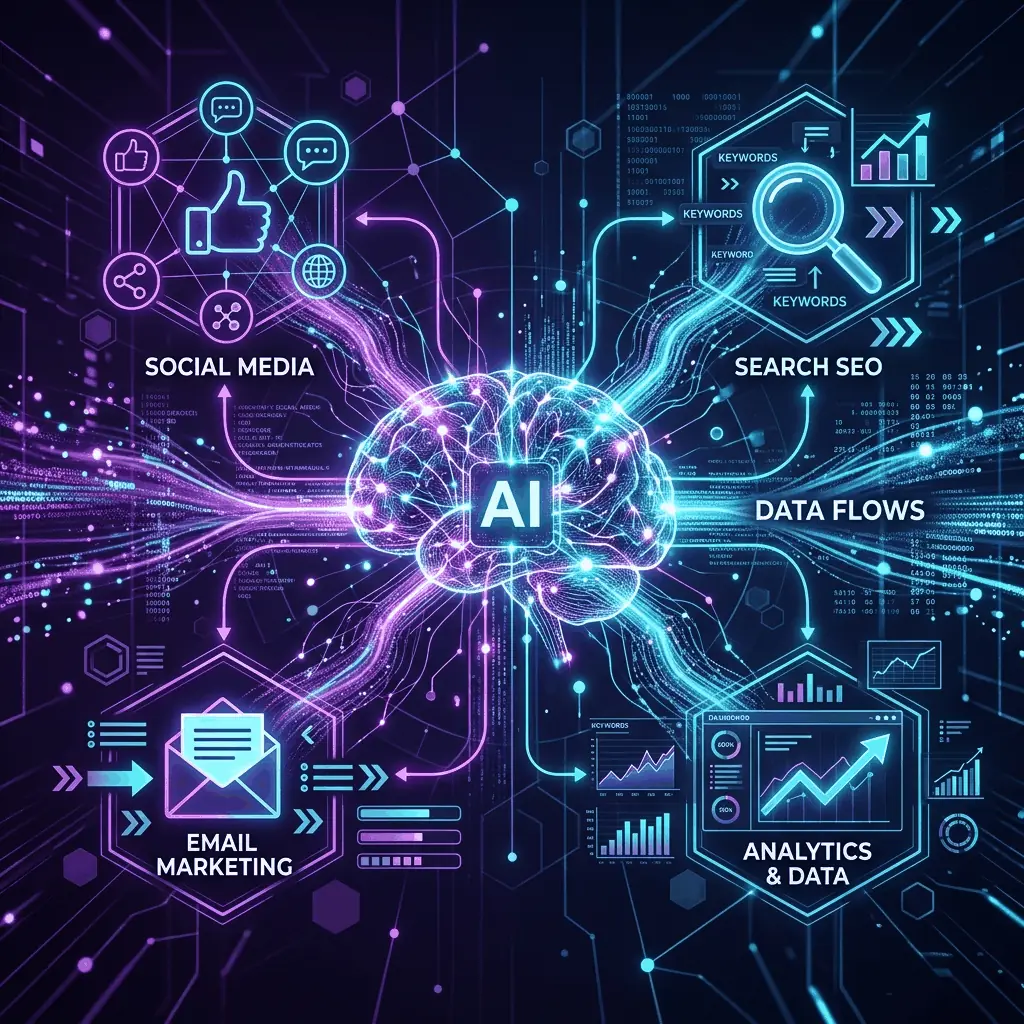
1. The AI Revolution in Digital Marketing
The digital marketing landscape is experiencing a structural paradigm shift driven by generative AI models like ChatGPT, Claude, Google Gemini, and Midjourney. What began as basic automation has matured into a system-level transformation. Marketing platforms are transitioning from keyword-matching systems to complex vector space networks capable of analyzing user intent and semantic contexts in real time.
To succeed in this environment, it is critical to understand what is ai-powered digital marketing. It is not simply using AI as a typing assistant; it is the integration of machine learning algorithms, natural language processing, predictive data systems, and automated software agents directly into your marketing infrastructure. This enables organizations to automate content curation, predict customer behavior with statistical precision, customize user interfaces dynamically, and target search audiences through structured semantic entities.
In the past, marketing was characterized by manual segmentations and static AB testing. Today, AI models parse massive customer data streams, generating real-time adjustments that optimize campaigns dynamically. For technical organizations, navigating this revolution requires moving beyond surface-level content scaling and focusing instead on building clean data architectures that AI crawlers can index and cite.
Technical Paradigm Shift
Traditional marketing operated on heuristics and manual testing. AI-powered digital marketing shifts the execution to neural networks, vector databases, and real-time inference pipelines, transforming how search engines interpret, rank, and present business websites.
2. How AI is Used in Digital Marketing Today
Modern businesses deploy artificial intelligence across several critical pillars to build competitive advantages. By integrating machine learning into standard workflows, marketing teams shift their focus from repetitive execution to architectural orchestration. Understanding how is ai used in digital marketing today requires looking at these five core operational domains:
Content Generation and Structuring
Instead of relying on writers to manually research and draft repetitive articles, content pipelines use large language models (LLMs) to synthesize initial drafts, cluster search topics, and generate structured data blocks. AI accelerates raw production speed by translating developer ideas into polished content, allowing teams to scale their informational reach while maintaining consistency across brand directories.
Predictive Analytics and User Pathways
Machine learning models analyze server logs, click-stream histories, and purchase funnels to identify conversion bottlenecks before they occur. By analyzing data trends, predictive analytics platforms calculate the statistical probability of a visitor converting, allowing ad networks to bid only on users who demonstrate high purchasing intent.
Conversational Interfaces and Automated Agents
Customer support has transitioned from rigid, tree-based chat systems to conversational AI agents. Powered by LLMs and Retrieval-Augmented Generation (RAG), these interfaces access local company wikis and CRM databases to resolve customer inquiries immediately, minimizing support queues and recording structured transaction data automatically.
Marketing Automation and Cohort Routing
Email campaigns and nurture flows utilize AI to adjust delivery times, modify headlines, and personalize subject lines based on user interaction histories. Instead of manual scheduling, the system executes triggers automatically as users progress through different touchpoints, driving engagement without human intervention.
Hyper-Personalization
Websites utilize dynamic rendering to adjust homepages, case studies, and services lists based on the visitor’s search terms and source demographics. If a visitor arrives from a SaaS-focused search query, the website automatically emphasizes CRM and cloud-integration services, improving user retention and conversions.
The Developer's Focus: How SEOs Use AI in 2024
Leading search specialists have abandoned manual metadata creation. In 2024, how seos use ai: boosting efficiency and productivity in 2024 is centered on automation: writing script engines to auto-inject JSON-LD schema blocks, running python libraries to identify crawl loops, using LLMs to structure XML sitemaps, and performing automated code audits. This technical integration ensures that websites remain lightweight, fast-loading, and easily readable by AI crawlers.
Does AI-Generated Content Work for SEO?
One of the most frequent questions from digital marketing teams is: does ai content work for seo? The answer is yes, but with major technical caveats. Google's Search Quality Guidelines state that the search engine rewards helpful, original content that demonstrates E-E-A-T (Experience, Expertise, Authoritativeness, Trustworthiness) regardless of how it is produced.
However, publishing unedited, thin AI text leads to severe ranking drops. Mass-generating pages without human review creates redundant index paths and crawl bloat, triggering search engine quality penalties. To make AI content work for SEO, developers and marketers must implement a "human-in-the-loop" framework: using AI to outline, structure, and drafts sections, while relying on subject-matter experts to add original research, proprietary data, verified code examples, and structured entity schema markups.
3. The Rise of GEO & AEO
We are transitioning away from traditional Search Engine Results Pages (SERPs) toward Generative Engine Optimization (GEO) and Answer Engine Optimization (AEO). Users are increasingly bypassing traditional search boxes to seek answers directly within LLM-powered interfaces like ChatGPT (SearchGPT), Google Gemini (AI Overviews), Perplexity, and Claude.
Rather than presenting a list of links for users to click, these engines compile synthesized answers, inserting inline citations that guide users to authoritative sources. The technical extraction mechanism relies on Retrieval-Augmented Generation (RAG) pipelines. When a user enters a query, the generative engine performs a vector search against its index, retrieves relevant text segments (nodes) from verified domains, inserts those segments into the LLM's prompt context, and generates the final answer with source citations.
For organizations seeking to capture these citations, optimizing site architecture is critical. Content must be formatted as clear, semantic Q&A blocks, utilizing verified schema scripts and precise technical descriptions. For businesses looking to capture these high-value placements, our technical GEO & AEO optimization services provide the structural engineering needed to rank within LLM vector databases.
To succeed in this changing market, organizations must incorporate new monitoring technologies. Understanding how can an ai search monitoring platform improve seo strategy is essential: these platforms scrape and track generative engine responses, analyzing how often your brand is cited, evaluating the sentiment of AI recommendations, and identifying key phrases required to trigger citations. By monitoring LLM response databases, developers can alter site content dynamically to ensure search crawlers can index and reference their pages accurately, improving long-term organic authority.
4. Will AI Replace Digital Marketers?
The rapid evolution of generative models has caused concern across the marketing sector. Many professionals ask: will ai replace digital marketers? A realistic assessment of the technology shows that AI will not replace digital marketers, but marketers who utilize AI will replace those who do not.
AI models excel at processing data, identifying search patterns, automating programmatic tasks, and generating draft content at scale. However, they lack the capacity for genuine strategic thinking, empathy, creative direction, and brand narrative construction. An LLM cannot conduct proprietary research, build client relationships, coordinate multi-channel campaigns, or verify the factual accuracy of its own output. It operates on pattern matching, not strategic reasoning.
The future of marketing relies on human-AI collaboration (human-in-the-loop). Marketers are transitioning from creators to operators: guiding LLM prompts, auditing outputs for brand voice, validating code structures, and checking facts. This ensures that the speed of AI is balanced by human judgment, protecting brands from errors and manual search penalties.
The AI Operator Framework
In this new landscape, human marketers act as supervisors who oversee the automated systems. The AI generates the baseline code, drafts, and data trends, while the human operator verifies E-E-A-T, inserts real-world experience, and coordinates cross-channel strategies.
5. Adapting Your Budget & Strategy for AI
Continuing to fund traditional digital marketing strategies is a recipe for index exclusion. To maintain visibility, companies must understand how to adapt seo budget for ai search optimization. This requires shifting budgets away from low-cost, high-volume writing services and allocating resources to technical optimizations, structured schema validation, and developer-driven site updates.
A modern SEO budget should be allocated across three primary pillars:
- Technical Infrastructure (40%): Prioritizing server speed, Next.js migrations, clean sitemap routing, crawl log monitoring, and secure database integrations to ensure search crawlers can parse pages instantly.
- Schema and Semantic Engineering (30%): Writing and validating custom JSON-LD schemas (such as Product, Service, LocalBusiness, and FAQPage) to pass clean, structured data directly to LLM vector indexes.
- Premium Content and Research (30%): Funding original studies, technical case studies, and expert-written guides that AI models cannot replicate, providing the authoritative data needed to secure RAG citations.
By shifting budgets toward development and authority building, brands can position themselves to capture high-intent search traffic. Keeping pace with future trends in digital marketing requires optimizing for voice and visual search, building agentic lead-generation systems, and deploying personalized landing pages dynamically. Learn more about our full suite of digital marketing services to prepare your business for the next decade of search.
Frequently Asked Questions
What is AI-powered digital marketing?
AI-powered digital marketing refers to the integration of machine learning algorithms, natural language processing, predictive data systems, and automated software agents into marketing workflows. It enables businesses to analyze massive data streams, automate content curation, personalize user experiences, and optimize search and advertising channels with high precision.
Does Google penalize AI-generated content?
No, Google does not penalize AI-generated content inherently. According to Google's Search Quality Guidelines, the search engine rewards helpful, original, and high-quality content that demonstrates E-E-A-T (Experience, Expertise, Authoritativeness, Trustworthiness) regardless of how it is produced. However, using automated tools or AI to manipulate search rankings (e.g., generating thin, repetitive pages to flood search indices) violates search quality policies and can lead to ranking drops or manual penalties.
What is the difference between SEO and GEO?
The primary difference lies in the destination and processing of user queries. Traditional SEO (Search Engine Optimization) focuses on optimizing web pages to rank in search engine results pages (SERPs) by matching keywords and building links. GEO (Generative Engine Optimization) optimizes content to be retrieved, cited, and recommended by Large Language Models and AI answer systems (like ChatGPT, Perplexity, and Google Gemini) which parse data using semantic vector search and Retrieval-Augmented Generation (RAG) pipelines.
How can small businesses leverage AI for marketing?
Small businesses can leverage AI by utilizing tools for automated copywriting, content brainstorming, smart customer support chatbots, and automated social media scheduling. They can also use predictive platforms to optimize local ad spend and leverage AI-driven sitemap structures to improve organic visibility in search engine AI overviews.
What are the future trends of AI in marketing?
Future trends include the rise of multi-modal search (optimizing for voice, visual, and text inputs), autonomous marketing agents executing real-time campaigns, hyper-personalized website layouts that change based on user intent, and advanced AI search monitoring platforms that track brand mentions in LLM response loops.
Will AI replace SEO agencies?
AI will not replace technical SEO agencies, but it will eliminate low-value agencies that focus solely on simple keyword stuffing and thin blog generation. Technical agencies like TechAuditPros, which specialize in schema engineering, server log auditing, performance optimizations, database integration, and generative engine optimization, are becoming increasingly vital for businesses navigating modern AI search ecosystems.
Get Your Free Consultation
Consult with our technical SEO and web development engineers. Get a roadmap for scaling your business search rankings.